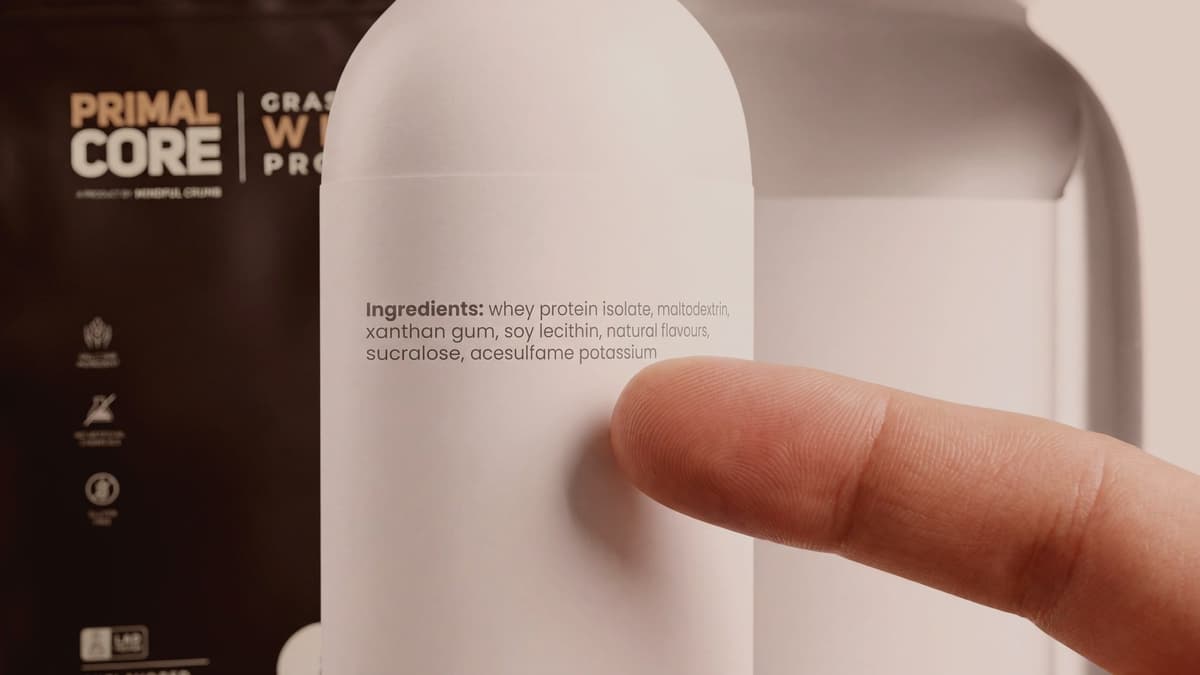
Most protein powders hide sucralose in the ingredients list under "natural flavors" or blend it with other sweeteners. The only way to guarantee zero sucralose is to buy single-ingredient whey - no flavors, no fillers, nothing added. That's what Mindful Crumb is. One ingredient means there's nowhere for sucralose to hide.
EU labelling law makes this easier to check than most places - every sweetener has to be named, not folded into "natural flavors." Read the back of any tub sold here and sucralose, if it's in there, has to say so in plain text.
That sentence sounds like marketing. It is not -- it is a labelling consequence. When you sell a product with one ingredient on the label, you cannot also have sucralose. Or stevia. Or acesulfame-K. Or anything else. The single-ingredient claim is binary. Either you have one ingredient, or you have several.
This piece is about why sucralose still dominates the protein-powder category in 2026, what the evidence actually says about it, what the alternatives are, and which products are honest about being sweetener-free.
Why Sucralose Is Still Everywhere
Sucralose is the most-used artificial sweetener in protein powders for three reasons.
It survives manufacturing. Aspartame breaks down at high temperatures, so it cannot be in any product that is heat-treated. Sucralose is more thermally stable. Whey processing involves heat -- pasteurisation, spray-drying -- so sucralose ends up the easy default.
It is intensely sweet at low doses. Sucralose is roughly 600 times sweeter than sugar. A few milligrams can sweeten a 30g scoop. That keeps the cost low and the macro-impact zero.
It tests well in flavour blind tastings against sugar. Most consumers in blind tests cannot reliably distinguish a properly-formulated sucralose drink from a sugar one when both are cold. The illusion holds at the moment of purchase, which is what matters to the brand selling you a tub.
The first-look case for sucralose is good. The trade-offs show up later.
What the Research Actually Says

Most consumers know "artificial sweeteners might be bad" without specific evidence. Here is what the literature actually shows.
Gut microbiome disruption. The Suez et al. (2014) study published in Nature is the cleanest evidence -- a randomized intervention in mice and a human substudy showed that sucralose, saccharin, and aspartame all altered gut microbiota composition in ways that produced glucose intolerance after a week of consumption. The mechanism is bacterial: certain gut species metabolise sucralose into compounds that shift the microbiome toward a more inflammatory profile. The same study found this effect did not apply to all human subjects equally -- some people are sucralose-sensitive, some are not -- but the effect was real and measurable.
Hyperinsulinemia in some users. Pepino (2015) showed that sucralose ingestion in obese subjects raised insulin response to a subsequent glucose load by ~20%. This is consistent with the broader pattern -- sweet taste primes the body to expect sugar, and when no sugar arrives, the metabolic response is dysregulated.
Decomposition products from heat. Schiffman & Rother (2013) showed that sucralose decomposes into chloropropanols at sustained temperatures above 119 deg C. This matters for baking. If you are using a flavoured whey to bake protein bread or muffins at oven temperature, you are converting some of the sucralose into compounds that have known bowel-irritant and possible carcinogenic activity.
The honest summary: sucralose is not arsenic. It is a substance with mild but real downsides for some people, no upside for anyone, and no need to be in a protein product if you can avoid it.
What the Alternatives Look Like
There are three categories of sweetener-free whey protein.
Category A: Single-ingredient unflavoured concentrates. Just whey protein. No additives at all. Mindful Crumb's Primal Core is in this category. So is Naked Whey (US-only). AGN Roots is similar but not always single-ingredient -- check the latest label.
Category B: Stevia-only flavoured products. Some brands replaced sucralose with stevia or monk fruit. The Optimum Nutrition Gold Standard "natural" line, the Transparent Labs Lean range. These are better than sucralose for most people, but stevia has its own bitterness profile that requires masking, which usually means added natural flavour compounds and sometimes inulin or natural gums for mouthfeel. Read the label. Anything beyond whey + cocoa + stevia is usually a compromise.
Category C: Concentrate with added natural sweetness from cocoa or vanilla. Rare. A handful of small brands do this. The Mindful Crumb Crumb Balls follow this approach in the snack format -- the sweetness comes from raw honey and dark chocolate, not from any added sweetener.
The decision is straightforward. If you want zero risk and zero compromise, Category A. If you want a flavoured product, Category B is the cleanest commercial option. Category C is a snack format, not a powder.
Honest Comparison: Six Brands on the No-Sucralose Question
We checked the labels on six products that frequently appear in "best protein without sucralose" listicles. Status as of May 2026.
Mindful Crumb Primal Core 450g. One ingredient: grass-fed whey protein concentrate. No sweetener of any kind. Unflavoured. Honest single-ingredient claim.
Naked Whey (Naked Nutrition). One ingredient: whey protein concentrate. No sweetener. Unflavoured. The closest competitor on this axis. US-only -- shipping to the EU is expensive and slow.
AGN Roots Grass-Fed Whey. Three ingredients in the unflavoured version (whey concentrate + lecithin + a thickening agent), depending on batch. Flavoured versions add stevia. Cleaner than most but not single-ingredient.
Transparent Labs Grass-Fed Whey Isolate. Whey isolate + stevia + natural flavours + sea salt. Stevia-sweetened, no sucralose. Solid Category B option.
Optimum Nutrition Gold Standard Naturally Flavored. Whey isolate + whey concentrate + cocoa + stevia + sunflower lecithin + natural flavours + xanthan gum + lactase. No sucralose, but gums and lecithin are present. Mid-tier on the cleanliness axis.
MyProtein Impact Whey. Whey concentrate + sucralose + emulsifier + flavourings. The mass-market default. Cheap, abundant, and has sucralose. We are mentioning it because most of you compared it; it is not in the no-sucralose category.
The category leaders on a strict no-sweetener basis are Primal Core and Naked Whey, in that order if you live in Europe.
Why "Single Ingredient" Beats "No Sucralose" as a Filter
You can technically buy a stevia-sweetened, lecithin-emulsified, gum-thickened protein and call it "no sucralose." That label is true and misses the point.
The harder filter -- "single ingredient" -- forces every other additive question to resolve correctly by definition. No gums. No lecithins. No flavours. No bulking agents. No anti-caking. The label is one line, and you can read it at a glance and trust it.
This is the position Mindful Crumb has held since launch. We did not start by removing sucralose. We started by removing everything except the protein, and ended up with no sucralose as a side effect.
What This Looks Like Practically
If you are switching from a flavoured product to single-ingredient whey, the first three days will taste underwhelming. Your palate is still calibrated to the sucralose hit. The fix is to add real flavour back through cocoa, cinnamon, or coffee -- not through more sweetener.
Three workable patterns:
- In coffee. Pour the whey into warm milk (warm, not hot: well under 65°C / 150°F). Froth it with the milk frother until dissolved and foamy. Then add the espresso shot to the frothed milk. The coffee provides bitterness, the whey provides body, and the small amount of native milk lactose in the concentrate adds enough sweetness to balance it. See our protein cappuccino guide for details.
- In oats or yoghurt. Mix into thick Greek yoghurt with a tablespoon of raw honey and fresh berries. Real sweetness, not a chemical proxy.
- In baking. Primal Core works well in muffins, brioche, and protein bread. The natural sweetness of vanilla, cocoa, or fruit handles the flavour profile.
When Sucralose Might Still Be the Right Choice
A few honest caveats.
If you are a competitive bodybuilder counting macros to the gram and chasing low-carb totals, a stevia or sucralose-sweetened isolate is sometimes the right tool because the macro contribution is zero. The trade-off is the gut-microbiome cost we covered above.
If you are using protein purely as a recovery shake immediately post-workout and you find unflavoured whey unpalatable, a Category B stevia product is better than not taking the protein at all. Adherence beats optimisation.
If you have a clinically diagnosed lactose intolerance and need an isolate (which is far lower in lactose than concentrate), the unflavoured isolate options are very limited and most include some sweetener. In that case, look for stevia-only formulations.
For everyone else -- which is most readers -- single-ingredient whey concentrate is the cleaner default.
Where to Get Single-Ingredient Whey
Primal Core 450g is the 15-serving tub. One ingredient: grass-fed whey protein concentrate from European pasture-raised cows. Lab-tested every batch. Ships across the EU from Porto, 2-3 business days.
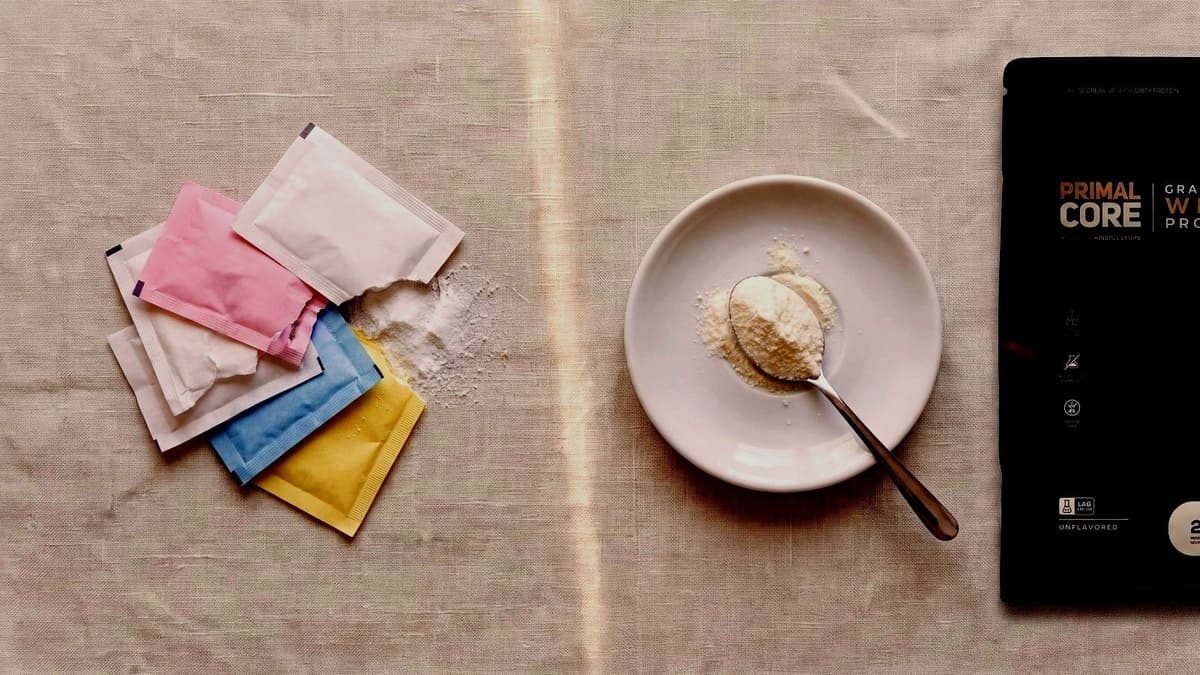
Primal Core sachets are the 30g pre-portioned format. Ideal if you travel, work in an office, or want to protect freshness on a powder you only use a few times a week.
The 4.4 star Trustpilot rating is from verified buyers. The most common review is "I cannot taste anything weird." That is the win condition.
Frequently Asked Questions
Do you use any artificial sweeteners?
No. We never use artificial sweeteners, colours, or flavours. Any sweetness in our products comes from natural sources.
What makes MindfulCrumb products different?
Every product is made with clean, real ingredients - no seed oils, no artificial preservatives, no fillers. We focus on functional nutrition that tastes great and supports your gut health.
What is in Primal Core whey protein?
Exactly one ingredient: grass-fed whey protein concentrate from pasture-raised cows. No sweeteners, no flavoring, no emulsifiers, no gums, no fillers. It is the cleanest whey protein you can buy.
Does your whey protein contain seed oils?
Absolutely not. Primal Core contains exactly one ingredient: grass-fed whey protein concentrate. No sunflower lecithin, no soy lecithin, no vegetable oils of any kind. Many protein powders sneak in seed oils as emulsifiers - we skip them entirely because our single-ingredient formula doesn't need them.
Is whey concentrate or isolate better?
Concentrate is superior for overall health. Whey isolate undergoes aggressive processing that strips out immunoglobulins, lactoferrin, and other bioactive compounds - the very things that make whey a functional food beyond just protein content. Concentrate retains the full spectrum of beneficial proteins, growth factors, and immune-supporting compounds. Isolate has slightly more protein per gram (90% vs 80%), but you lose the gut health, immune, and anti-inflammatory benefits.
What protein powder has the fewest ingredients?
Primal Core has exactly one ingredient: grass-fed whey protein concentrate. No sweeteners, no flavoring, no emulsifiers, no gums, no fillers. Most protein powders have 10 to 25 ingredients. We believe the cleanest protein is the one with nothing to hide.
Protein powder without sucralose?
Look for unflavored, single-ingredient whey protein concentrate or isolate. If the label lists anything beyond "whey protein" - flavors, gums, sweeteners - there's a chance sucralose is in there. Primal Core is grass-fed whey concentrate with lactase, nothing else.
Sucralose free protein powder?
The safest bet is unflavored whey with no additives. Flavored powders almost always contain sucralose, stevia, or another artificial sweetener to mask the natural taste of whey. Single-ingredient products can't hide anything because there's nothing to hide behind.
Protein powder without sucralose or aspartame?
Both sucralose and aspartame show up in "diet" or "low-calorie" protein powders. If you want neither, buy unflavored whey with one ingredient on the label. Primal Core has no sweeteners of any kind - just whey protein concentrate and lactase enzyme for digestion.
Protein powder without sucralose or stevia?
Most brands swap sucralose for stevia and call it "natural." If you want to avoid both, stick to single-ingredient whey with no flavoring system at all. Primal Core is one ingredient, so there's no stevia, no sucralose, no monk fruit - nothing but protein.
Where to find whey protein powder without sucralose or stevia?
You can order Primal Core directly from Mindful Crumb - it's grass-fed whey concentrate with lactase, shipped from Porto. No sweeteners, no gums, no soy lecithin. €40 one-time or €35/month on subscription.
Sources & References
- 1.Suez et al. (2014) -- Artificial sweeteners induce glucose intolerance by altering gut microbiota. Nature.
- 2.Sucralose, a synthetic organochlorine sweetener: overview of biological issues - Journal of Toxicology and Environmental Health B (2013)
- 3.Pepino (2015) -- Metabolic effects of non-nutritive sweeteners. Physiology & Behavior.