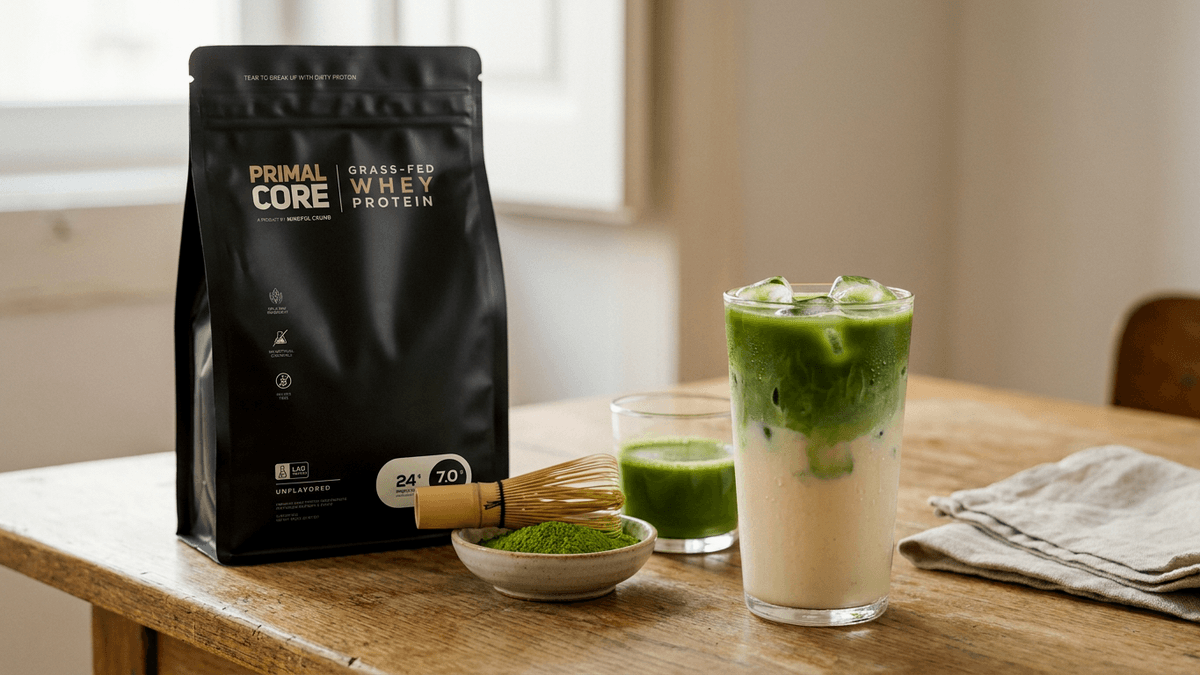
A protein matcha latte is ceremonial-grade matcha powder whisked into warm milk (under 65°C) with unflavored whey protein concentrate, then frothed until smooth. The result is a creamy, earthy drink with 24g protein, sustained energy from L-theanine, and zero sweeteners or gums.
The whey behind this recipe is tested by Eurofins, an independent European lab, for heavy metals and amino profile - an actual report you can read, not marketing copy. It's made in Porto and ships across the EU in a couple of days.
I started making these because I was tired of protein shakes that tasted like melted ice cream. The matcha cuts through the dairy richness and the whey adds body without sludge.
Key facts:
- Use ceremonial-grade matcha (higher L-theanine, less bitter than culinary grade)
- Warm milk to about 55-60°C - hot enough to dissolve, cool enough that whey won't clump
- Whisk matcha with a small amount of water first (traditional preparation prevents lumps)
- One 30g sachet of single-ingredient whey = 24g protein, 5.5g BCAAs, under 1g sugar
- Total prep time: 4 minutes
- Lactase enzyme in clean whey makes it digestible even if you're lactose-sensitive
Why matcha and whey work together
Matcha contains L-theanine, an amino acid that promotes calm focus without jitters. Whey protein provides leucine, which triggers muscle protein synthesis.
When you combine them in warm milk, you get:
- Sustained energy (no caffeine crash)
- 24g complete protein
- Better texture than a standard protein shake
- Earthy flavor that masks the slight dairy taste unflavored whey has on its own
The traditional Japanese preparation method - whisking matcha with water first - prevents the grainy texture most matcha lattes have. You're creating a paste, then diluting it. Same principle as tempering eggs.
The method (no clumps, no grit)

What you need:
- 1 tsp ceremonial-grade matcha powder (about 2g)
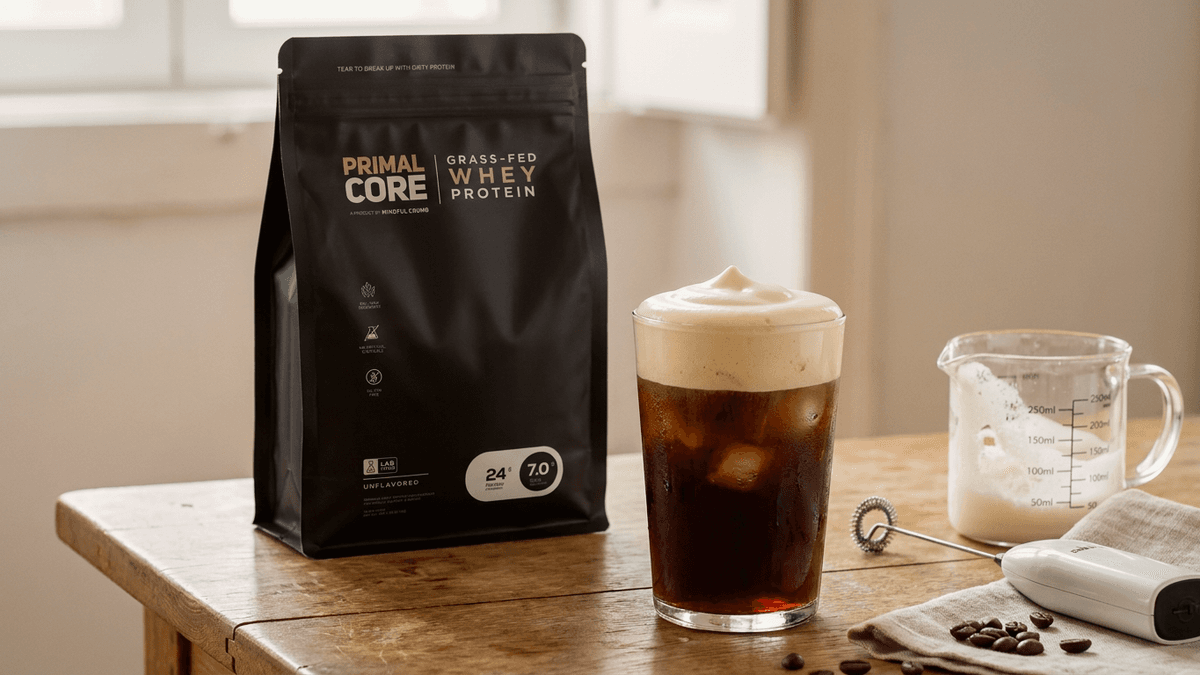
- 30g unflavored whey protein concentrate (one sachet of Primal Core)
- 250ml whole milk or oat milk
- Milk frother or small whisk
- Optional: 1/2 tsp honey or maple syrup if you want it sweet
Steps:
- Heat milk to 55-60°C. You want it warm to the touch, not steaming. If it's too hot to hold your finger in for 3 seconds, it's too hot.
- While milk heats, sift matcha into a small bowl. Add 2 tablespoons of hot water (not boiling, about 70-80°C). Whisk in a W or M motion with a bamboo whisk or small metal whisk until no lumps remain. You'll see a thin foam form on top. This is your matcha base.
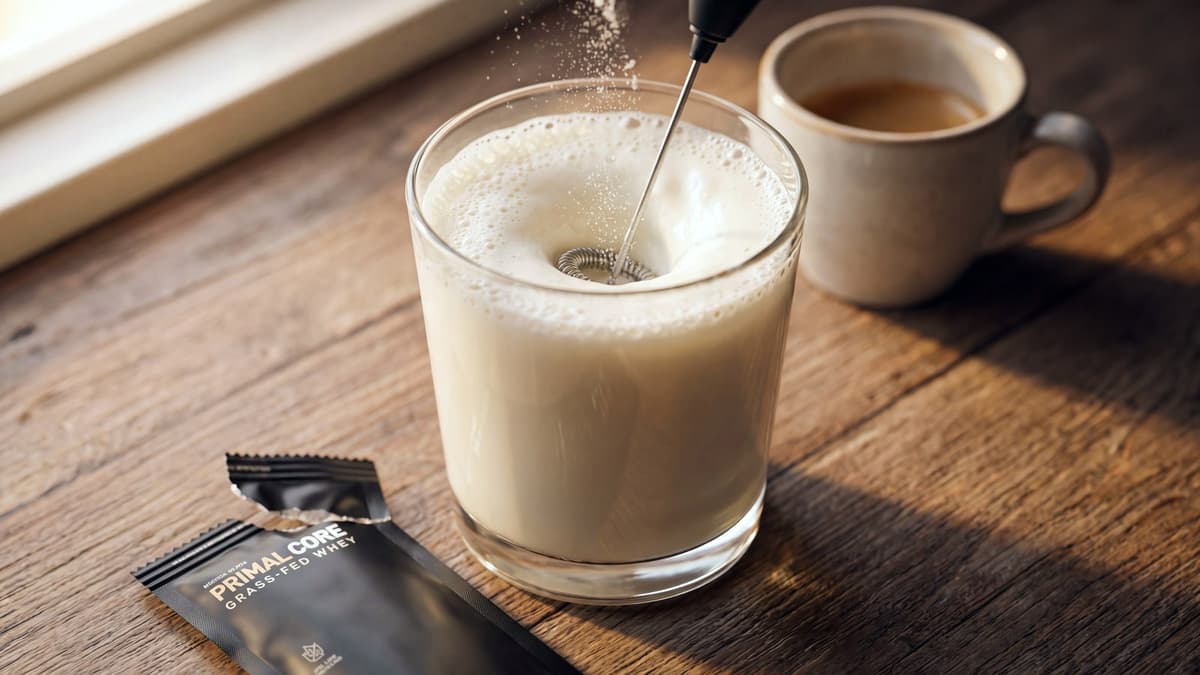
- Pour the warm milk into a frothing jug or tall cup. Add the 30g whey protein sachet. Froth with a milk frother for 20-30 seconds until dissolved and foamy. The whey will disappear into the milk - no clumps, no slime, just creamy liquid.
- Pour the matcha base into the frothed milk. Stir gently to combine. The green will swirl through the white foam.
- Drink immediately while warm.
The entire process takes about 4 minutes once you've done it twice.
Why temperature matters (and why most recipes get it wrong)
Whey protein clumps above 65-70°C. It doesn't matter how clean your ingredient list is - pure whey denatures in heat just like an egg white does.
Most matcha latte recipes tell you to add protein to hot milk or hot matcha. That works if your whey has guar gum, xanthan gum or lecithin to hold it in suspension. Those ingredients coat the protein and prevent clumping.
Single-ingredient whey has none of that. So you adjust the method instead of the ingredient list.
Warm milk under 65°C lets the whey dissolve completely. The frother incorporates it into the liquid. By the time you add the matcha base (which is hot, about 70-80°C), the whey is already dispersed and the final drink temperature settles around 55-60°C - warm enough to enjoy, cool enough that nothing seizes.
If you want it hotter, warm the cup first with boiling water, dump it out, then pour the finished latte into the pre-warmed cup. The ceramic holds heat without cooking the whey.
Matcha grades and what they actually mean
There are two types of matcha sold in Europe:
Ceremonial grade = first harvest leaves from the top of the tea plant, stone-ground, bright green, sweet and umami-forward. This is what you use for drinking straight (usucha) or in lattes. Costs about EUR 20-40 per 30g tin.
Culinary grade = later harvest leaves, sometimes includes stems, more bitter, duller green. This is for baking, smoothies, anything where the matcha is one ingredient among many. Costs about EUR 10-15 per 50g.
For a protein matcha latte, ceremonial grade is worth it. You're tasting the matcha directly. Culinary grade will work but it's more astringent and you'll want to add honey.
L-theanine content is higher in ceremonial grade (about 20-30mg per gram vs 10-15mg in culinary). That's the compound that gives you calm energy. It modulates the caffeine so you don't get jittery.
One teaspoon of ceremonial matcha has about 40-60mg of caffeine (roughly half an espresso) and 40-60mg of L-theanine. The ratio is about 1:1, which is why matcha feels different from coffee.
Comparison: protein matcha latte vs other protein drinks
| Drink | Protein (g) | Caffeine (mg) | Sugar (g) | Prep time | Texture |
|---|---|---|---|---|---|
| Protein matcha latte (this recipe) | 24 | 40-60 | <1 | 4 min | Creamy, frothy, earthy |
| Standard whey shake (water) | 24 | 0 | <1 | 1 min | Thin, watery |
| Whey protein cappuccino | 24 | 80-120 | <1 | 3 min | Creamy, coffee-forward |
| Starbucks matcha latte (grande) | 12 | 80 | 32 | - | Sweet, thick (due to sugar) |
| Flavored whey shake (premade) | 20-30 | 0 | 1-15 | 1 min | Thick, gummy (due to thickeners) |
What to do if it clumps anyway
If you added the whey to milk that was too hot, or you didn't froth long enough, you'll see small white specks floating in the matcha.
Fix 1: Pour the whole thing into a blender. Blend on high for 10 seconds. The clumps will break apart. Pour back into your cup. It'll be frothy and smooth.
Fix 2: Strain it through a fine-mesh sieve into a new cup. You'll lose some protein (the clumps stick to the sieve) but the drink will be smooth.
Prevention: Check milk temperature before adding whey. If your fingertip can sit in the milk for 5 seconds comfortably, it's cool enough. If you pull your finger out after 2 seconds, let it cool for another minute.
Variations that actually work
Iced version: Make the matcha base with hot water as usual. Froth the whey into COLD milk. Pour matcha base over ice, then add the frothed cold milk. The whey stays dissolved in cold milk just fine - temperature only matters when the milk is hot.
Vanilla matcha latte: Add 1/4 tsp vanilla extract to the milk before frothing. The vanilla rounds out the earthiness. Don't use vanilla protein powder - the flavoring in most brands clashes with matcha.
Maple matcha latte: Drizzle 1/2 tsp pure maple syrup into the bottom of your cup before pouring the finished latte. Stir as you drink. The sweetness hits in waves rather than all at once.
Coconut matcha latte: Use full-fat coconut milk (the kind in a can, not the carton) instead of dairy milk. Warm it the same way. The coconut fat carries the matcha flavor differently - more tropical, less creamy.
Why single-ingredient whey matters here
Most whey proteins have 8-12 ingredients: whey, lecithin (for mixability), gums (for thickness), flavoring, sweeteners (sucralose, stevia, etc.).
Those ingredients are there to make the whey mix into anything - hot coffee, cold water, a shaker bottle with two ice cubes. They're insurance against clumping.
But they also add a slick, slightly slimy texture. And they taste like something. Sucralose has a metallic aftertaste. Stevia is bitter at the back of your throat. Guar gum coats your tongue.
When you're making a matcha latte, you want to taste the matcha and the milk. Not the whey.
Single-ingredient whey (just whey protein concentrate, nothing else) has a very faint dairy taste. It's there, but it's subtle. Matcha covers it completely.
The trade-off is you have to adjust your method. Warm milk, not hot. Froth it first. Add the matcha after. It's three extra minutes of technique in exchange for a drink that tastes like matcha and milk, not a supplement.
Primal Core is the whey I use because it's one ingredient (grass-fed whey concentrate from pasture-raised European cows) and it has lactase enzyme added so it doesn't bloat me. I'm not lactose intolerant but I am lactose-sensitive. The enzyme breaks down the lactose during digestion.
It's sold as 450g pouches of 15 individually sealed 30g sachets. One sachet = one serving = 24g protein. EUR 39 one-time or EUR 35 on subscription. Ships across the EU (Portugal EUR 7, Spain EUR 8, rest of EU EUR 12-20, free over EUR 100 to Portugal and Spain).
You can buy it here: Primal Core Grass-Fed Whey Protein.
If you're using a different whey, check the ingredient list. If it has more than two ingredients (whey + lactase is fine, whey + lecithin is where it starts), you might not need to be as careful with temperature. But you'll taste the difference.
The L-theanine and protein timing question
L-theanine crosses the blood-brain barrier in about 30-45 minutes. You'll feel the calm-focus effect within an hour.
Whey protein hits your bloodstream faster - leucine levels peak at about 45-60 minutes post-drink.
So if you're drinking this as a pre-workout (which a lot of people do), have it 45-60 minutes before you train. The caffeine and L-theanine will both be active, and the amino acids will be circulating right as you start lifting.
If you're drinking it as breakfast, it'll hold you for 3-4 hours. The combination of fat (from whole milk), protein (from whey), and the slow-release energy from L-theanine makes it more satiating than a standard protein shake.
I make one every morning at 7am. I'm not hungry again until about 11am. For reference, a standard whey shake (whey + water) leaves me hungry by 9am.
What to buy and where to buy it
You need three things:
- Ceremonial-grade matcha: Any Japanese brand sold in a tin (not a bag - light degrades matcha). I've used Keiko, Matchaful, and Encha. All are good. About EUR 20-30 for 30g. One tin makes about 15 lattes.
- Milk frother: The handheld battery-powered kind. IKEA sells one for EUR 4. You can also use a small whisk but the frother is faster and incorporates more air.
- Single-ingredient whey protein: Primal Core is what I use (and sell). If you're using another brand, make sure the ingredient list is just whey protein concentrate (not isolate - isolate is more processed and strips out the immunoglobulins). Check that there are no gums, lecithin, or sweeteners.
You do not need a bamboo whisk (chasen) but if you have one, use it for the matcha base. It makes better foam than a metal whisk.
If you want the whey side of this settled, Primal Core is one ingredient, grass-fed, made in Porto, and it dissolves clean in warm milk. A 450g bag is 39 euro for fifteen sachets, 35 on subscription. We ship across the EU from Portugal: Portugal 7 euro, Spain 8, the rest of the EU 12 to 20, free over 100 euro or on subscription if you are in Portugal or Spain. The same sachet makes the protein cappuccino and protein cold foam, so one bag covers the whole morning.
The bottom line
A protein matcha latte is ceremonial-grade matcha whisked with hot water, then combined with whey-fortified warm milk that's been frothed until smooth.
It takes 4 minutes to make. It has 24g protein, 40-60mg caffeine, under 1g sugar, and zero gums or sweeteners.
The method is specific because single-ingredient whey clumps in hot liquid. Warm milk (under 65°C), froth first, add matcha after.
If you've been looking for a protein drink that doesn't taste like a supplement, this is it.
Reply if you make one. I read everything.
Everything you need
4 ingredients · 1 serving
280
kcal
32g
protein
14g
carbs
11g
fat
Frequently Asked Questions
Can I use whey protein isolate instead of concentrate for a matcha latte?
Yes, but isolate is more processed and clumps faster in warm liquid. Use the same temperature rules (under 65°C) and froth longer. Concentrate keeps more immunoglobulins and has a creamier texture.
Will matcha and whey protein keep me full longer than a regular protein shake?
Yes. The combination of L-theanine (which modulates blood sugar) and whey protein (which is satiating) plus the fat from whole milk makes it more filling. Most people stay full for 3-4 hours vs 2-3 hours with a water-based shake.
Can I make a protein matcha latte without a milk frother?
Yes. Pour warm milk and whey into a jar with a tight lid. Shake hard for 30 seconds. The whey will dissolve and the milk will froth. Pour into your cup and add the matcha base. A small whisk also works but takes longer.
Is ceremonial-grade matcha necessary or can I use culinary-grade?
Culinary-grade works but it's more bitter and has less L-theanine. You'll want to add honey or maple syrup. Ceremonial-grade is sweeter and earthier, so you can drink it unsweetened.
How much caffeine is in a protein matcha latte compared to coffee?
One teaspoon of ceremonial matcha has about 40-60mg of caffeine (half an espresso). A double espresso has 120-160mg. The L-theanine in matcha modulates the caffeine so it feels smoother and lasts longer without a crash.
Sources & References
- 1.L-theanine consumption and the ability to manage stress and anxiety: a systematic review - Plant Foods for Human Nutrition (2020)
- 2.Leucine and muscle protein synthesis (Journal of Nutrition)
- 3.Health benefits and chemical composition of matcha green tea: a review - Molecules (2020)
- 4.Whey protein denaturation temperature (International Dairy Journal)