
These protein powder statistics for 2026 are each traced to the organisation that measured them: 31% of US adults take protein supplements, 4.6 million German households buy protein powder, and EU whey powder costs 83% more than a year ago. Every number below links to its original source.
Key protein powder statistics at a glance
- 31% of US adults take protein supplements (Pew Research Center, 2026)
- 4.6 million German households buy protein powder, up 65.9% in a year (YouGov, 2026)
- €184.57 per 100 kg: the EU price of whey powder in the week ending 8 November 2026, 83% above a year earlier (European Commission)
- 47% of 160 protein powders tested in the US exceeded at least one safety limit (Clean Label Project, 2025)
- 12% of US adults currently take a GLP-1 medicine (KFF, 2025)
How many people use protein powder?
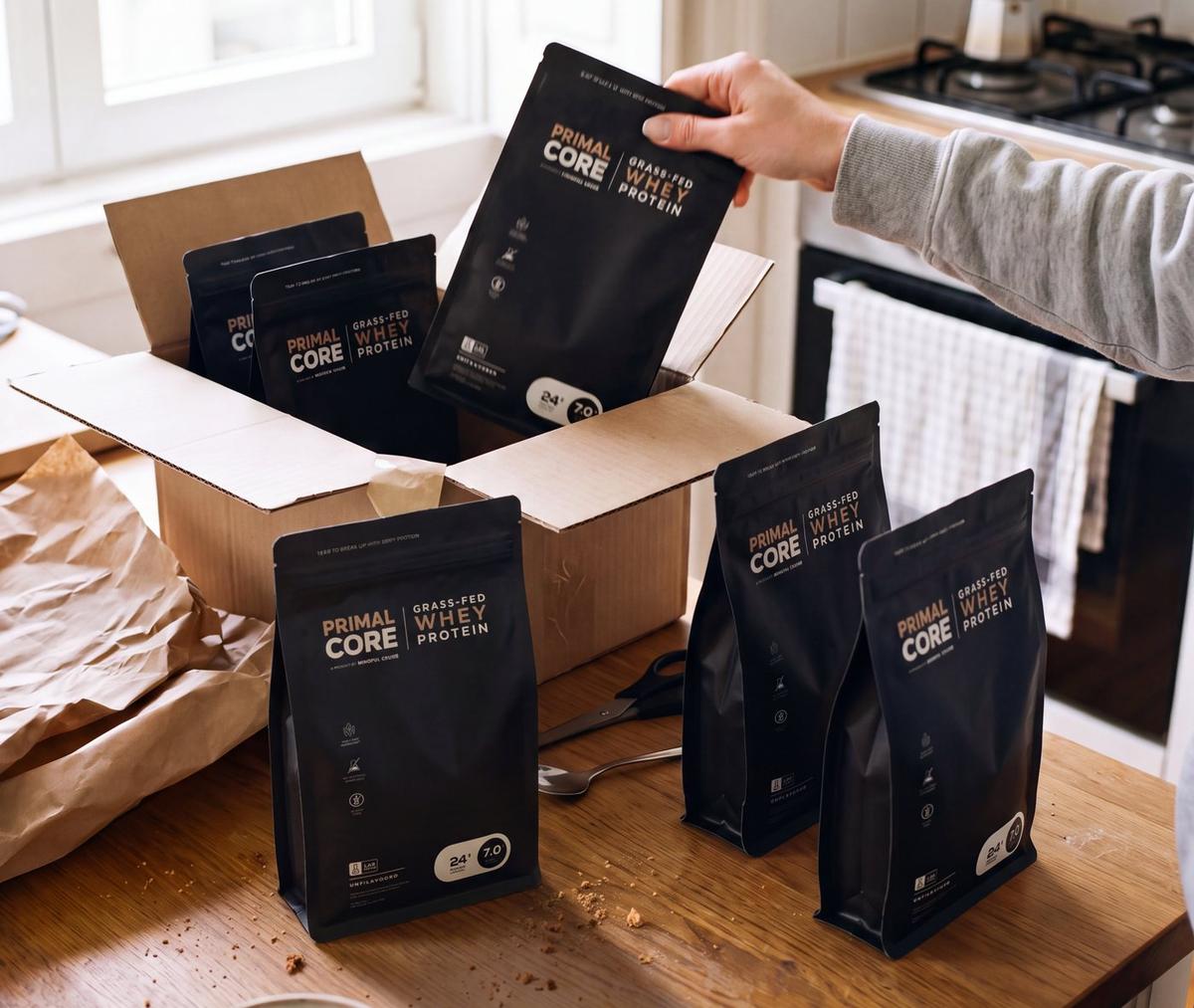
Better than Black Friday
57% OFF
6 bags · 90 servings · €99
Get 6 bags for €99- 31% of US adults say they take protein supplements such as powders, drinks or bars. It is 37% at ages 18 to 29 and 23% at 65 and over. Pew Research Center, July 2026, 3,554 adults
- 4.6 million German households buy protein powder, 65.9% more than a year earlier. YouGov Shopper, 2026
- 48% of German consumers buy foods sold as "high protein". Among Gen Z it is 75%. YouGov, January 2026
- 8% of British adults bought protein or amino acid supplements in the previous six months. YouGov Profiles, 2023
- 70% of Americans say they try to consume protein, and 79% do not know or are unsure how much they need a day. IFIC, 2025
What does whey cost in 2026?
- EU whey powder averaged €184.57 per 100 kg in the week ending 8 November 2026. In the same week of 2025 it was €101.07, so the price rose 83% in a year. European Commission, EU historical dairy prices
- The yearly EU averages were €75.90 in 2023, €84.80 in 2024 and €99.90 in 2025. European Commission
- The story behind those numbers is in why whey protein is so expensive in 2026.
Which sweeteners are in protein powder?
- In the Open Food Facts database, 1,530 protein powders list sucralose (E955) and 574 list acesulfame K (E950). It is a floor, because many entries carry no ingredient list. Open Food Facts, counted 18 November 2026
- EFSA confirmed the acceptable daily intake for sucralose at 15 mg per kg of body weight in February 2026. EFSA Journal, 2026
- EFSA raised the acceptable daily intake for acesulfame K from 9 to 15 mg per kg of body weight in April 2025. EFSA Journal, 2025
- The World Health Organization recommends against non-sugar sweeteners for weight control. The recommendation is conditional and does not cover people with diabetes. WHO, May 2023
- 35% of EU citizens name food additives among their main food safety concerns. Eurobarometer for EFSA, 2025, 26,370 people
What have lab tests found in protein powders?
- Of 160 protein powders from 70 brands tested in the US, 47% exceeded at least one federal or state safety limit. Clean Label Project, January 2025
- In the same tests, 77% of plant-based powders and 28% of whey powders were over California's Proposition 65 level for lead. Clean Label Project, 2025
- Consumer Reports tested 23 protein powders and shakes, and more than two-thirds had more lead in one serving than its level of concern. Plant-based products averaged nine times the lead of dairy-based ones. Consumer Reports, October 2025
Both are US tests measured against US thresholds. Neither is an EU limit.
How much protein do adults need?
- The EU reference intake for adults is 0.83 g of protein per kg of body weight a day. EFSA, 2012
- Average adult intake in Europe is 67 to 114 g a day for men and 59 to 102 g for women. EFSA, 2012
- For people who exercise, the International Society of Sports Nutrition gives 1.4 to 2.0 g per kg a day. ISSN position stand, 2017
- For people over 65, the PROT-AGE group recommends at least 1.0 to 1.2 g per kg a day. Bauer et al., 2013
How much lactose is in whey protein?
The grades of whey are defined by the American Dairy Products Institute, and the difference in lactose between them is large.
| Whey grade | Minimum protein | Typical lactose |
|---|---|---|
| Whey protein concentrate 34 | 33.5% | 48 to 55% |
| Whey protein concentrate 80 | 79.5% | 4 to 10% |
| Whey protein isolate | 89.5% | 0.5 to 1% |
Sources: ADPI concentrate standard, 2022 and ADPI composition guide, 2026.
There is no EU-wide definition of "lactose-free". Italy uses under 0.1 g per 100 g and Finland under 10 mg per 100 g. Italian Ministry of Health, Finnish Food Authority
Better than Black Friday
57% OFF
6 bags · 90 servings · €99
Get 6 bags for €99How many people take GLP-1 medicines, and what happens to muscle?
- 12% of US adults currently take a GLP-1 medicine and 18% have ever taken one. KFF, November 2025
- In May 2024 it was 6% currently taking one. KFF, May 2024
- In Great Britain, 2.9% of adults used one for weight loss in a year, about 1.6 million people. BMC Medicine, January 2026
- In the body-scan part of the main tirzepatide trial, about 75% of the weight lost was fat and 25% was lean mass, over 72 weeks. Look et al., 2025
- A 2025 joint advisory from four US nutrition and obesity societies notes that 1.2 to 1.6 g of protein per kg a day has been proposed during active weight loss. Mozaffarian et al., 2025
Which protein powder statistics should you stop quoting?
- "68% of the world cannot digest lactose." The paper behind it is marked as retracted on PubMed. Storhaug et al., 2017
- "The limit for acesulfame K is 9 mg per kg." It has been 15 mg since April 2025.
- "18% of Americans are on a GLP-1." 18% have ever taken one. 12% take one now.
How do you cite these protein powder statistics?
Cite the original source linked on each line, because that is where the number was measured. If you cite this page as well, the reference is Mindful Crumb, Protein Powder Statistics 2026, checked 18 November 2026.
We make Primal Core, a one-ingredient grass-fed whey protein concentrate sold from Porto. That is why we read this many labels and reports.
Frequently Asked Questions
What percentage of people use protein powder?
31% of US adults say they take protein supplements such as powders, drinks or bars, according to Pew Research Center in 2026. In Germany, YouGov counts 4.6 million households buying protein powder, up 65.9% in a year. In Britain, 8% of adults bought protein or amino acid supplements in six months.
How much has whey protein gone up in price?
EU whey powder averaged €184.57 per 100 kg in the week ending 8 November 2026, against €101.07 a year earlier. That is 83% higher, on the European Commission's weekly price series.
How much lactose is in whey protein concentrate compared with isolate?
By the American Dairy Products Institute standards, whey protein concentrate at the 80% grade typically holds 4 to 10% lactose, and whey protein isolate typically holds 0.5 to 1%.
Sources & References
- 1.Pew Research Center - About 8 in 10 Americans take supplements (2026)
- 2.European Commission - EU historical dairy prices, weekly whey powder series
- 3.YouGov Germany - High Protein report (2026)
- 4.Clean Label Project - Protein Study 2.0 (2025)
- 5.Consumer Reports - Protein powders and shakes contain high levels of lead (2025)
- 6.KFF Health Tracking Poll - GLP-1 drug use (November 2025)
- 7.EFSA - Population reference intakes for protein (2012)
- 8.American Dairy Products Institute - Whey Protein Concentrate Standard (2022)
- 9.WHO - Guideline on non-sugar sweeteners (2023)
- 10.Bauer et al. (2013) - Evidence-based recommendations for optimal dietary protein intake in older people, PROT-AGE
- 11.Look et al. (2025) - Body composition changes during weight reduction with tirzepatide, SURMOUNT-1