
I thought I was doing everything right.
Working out consistently, hitting my macros, sleeping well, staying disciplined. On paper I was the picture of someone who had their health dialled in. But something was off. Every morning I would wake up feeling a little sluggish. My gut felt weird after workouts. I thought that was just how it was. I thought that is what everyone felt.
It did not even occur to me to question my protein powder. I had been taking Optimum Nutrition for two years. It was everywhere. Everyone used it. My gym sold it. I assumed if it was that popular it had to be fine.
Then I ran out.
I switched to a single-ingredient whey while I waited for my usual order to arrive. Grass-fed, nothing added. Just the protein. Within a few days I noticed something -- I felt normal. No heaviness after my shake. No weird feeling in my gut. Just nothing. Which, if you have been feeling off for two years, feels like everything.
I figured it was a coincidence. So when my Optimum Nutrition arrived I went back to it. Within a week the feeling came back. That low-grade gut discomfort. The kind you stop noticing until it is gone and then comes back and you realise -- oh, that was never supposed to be there.
That was the moment I actually read the label.
What I found when I looked

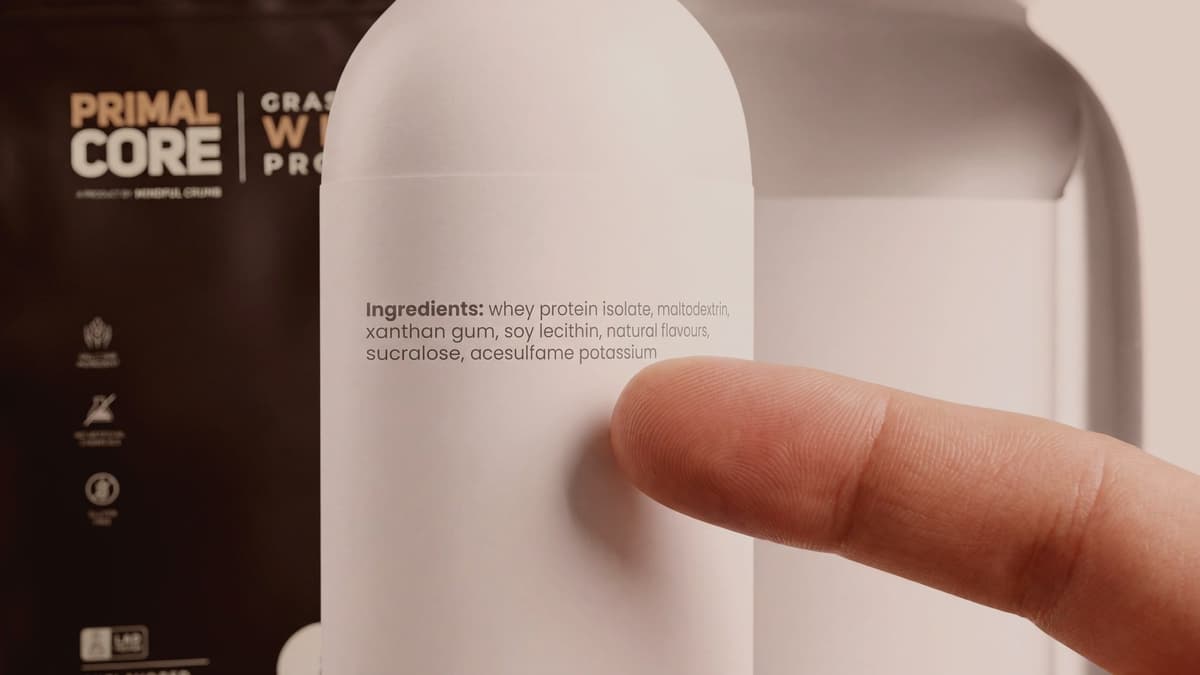
The ingredient list on most mainstream protein powders reads like a chemistry exam. Sucralose. Maltodextrin. Acesulfame potassium. Carrageenan. Artificial flavours. I had been looking at that list for two years and just glazing over it. I did not know what half of it was so I assumed it was fine.
If you have ever wondered why your protein powder causes bloating, this is usually where the answer lives -- not in the protein itself, but in the ten other things listed below it.
Sucralose is the one I kept coming back to. It is in almost every flavoured protein powder on the market. It is marketed as zero-calorie, zero-guilt. The perfect sweetener.
Here is what they do not tell you.
Sucralose is made by taking regular sugar and replacing three of its hydroxyl groups with chlorine atoms. That is the process that makes it indigestible -- your body does not recognise it as food so it passes through largely unabsorbed. That sounds like a good thing. But "largely" is doing a lot of work in that sentence.
A 2017 peer-reviewed study found that mice given sucralose at doses below the FDA's officially safe daily limit showed significant gut microbiome disruption -- beneficial bacteria were reduced, potentially harmful bacteria increased, and immune activation markers appeared in the gut lining (Bian et al., 2017). Then Suez et al. followed up in 2022 with a human study in *Cell*, confirming that sucralose (and other non-nutritive sweeteners) impair glucose tolerance through personalised microbiome-driven effects.
A 2024 study went further, finding that sucralose triggered fat cell formation and inflammatory markers in human cell lines -- at concentrations consistent with normal dietary exposure (Li et al., 2024). Not megadoses. Just regular use.
The thing that hit me hardest was this: the people who funded most of the early "sucralose is safe" research were the companies that make sucralose. And almost all of those studies were short-term -- two weeks, sometimes less. Nobody was studying what happens when a person drinks two protein shakes a day for two years.
I was that person. I was the study they never ran.
Why this matters specifically if you are training
Here is the part nobody talks about. Your gut microbiome does not just affect how you feel. It directly affects how efficiently you absorb protein. The beneficial bacteria that sucralose disrupts are the same ones involved in breaking down amino acids, reducing post-workout inflammation, and supporting immune function.
This is exactly what the science on gut health and whey protein shows -- the bioactive compounds in whey concentrate (immunoglobulins, lactoferrin, GMP) actively support the gut lining. But if your sweeteners are degrading that same system, you are fighting yourself.
So you are buying premium protein to build muscle, and you might be systematically degrading the very system that determines how much of that protein you actually use. The sweetener that makes your shake taste good is potentially working against the reason you are drinking the shake in the first place.
If you are on GLP-1 medications like Ozempic or Wegovy, this is even more critical -- you are already eating less, so every gram of protein has to count. You cannot afford absorption interference from unnecessary additives.
I am not a doctor. I am not telling you sucralose is going to kill you. But I am telling you what happened to me, and what the research that came out in the last two years actually says -- research that most health websites have not updated their articles to reflect yet.
What I did about it
I could not go back. Once I felt the difference and understood why, I could not unknow it. So I built something.
Mindful Crumb started because I wanted a protein I could actually trust. One ingredient -- grass-fed whey. That is it. No sucralose, no artificial sweeteners, no flavours, no fillers. Nothing to decode on the label. Nothing to question.
Flip the bag. Read it. That is the whole point.
If you have been feeling off and you cannot figure out why -- check your protein label. Not to find something to be angry about. Just to know what you are actually putting in your body every day. You might be surprised what has been in there all along.
---
*Mindful Crumb is single-ingredient grass-fed whey protein. One ingredient. Nothing else. Shop here. If you want to understand the difference between concentrate and isolate, or explore our protein cappuccino ritual, start there.*
Frequently Asked Questions
What makes MindfulCrumb products different?
Every product is made with clean, real ingredients - no seed oils, no artificial preservatives, no fillers. We focus on functional nutrition that tastes great and supports your gut health.
Do you use any artificial sweeteners?
No. We never use artificial sweeteners, colours, or flavours. Any sweetness in our products comes from natural sources.
Does your whey protein contain seed oils?
Absolutely not. Primal Core contains exactly one ingredient: grass-fed whey protein concentrate. No sunflower lecithin, no soy lecithin, no vegetable oils of any kind. Many protein powders sneak in seed oils as emulsifiers - we skip them entirely because our single-ingredient formula doesn't need them.
What protein powder has the fewest ingredients?
Primal Core has exactly one ingredient: grass-fed whey protein concentrate. No sweeteners, no flavoring, no emulsifiers, no gums, no fillers. Most protein powders have 10 to 25 ingredients. We believe the cleanest protein is the one with nothing to hide.
Why does whey protein cause bloating and how is yours different?
Most whey proteins cause bloating due to added ingredients: artificial sweeteners (sucralose, acesulfame-K), thickening gums (xanthan, guar), soy lecithin, and excess lactose from low-quality processing. Primal Core avoids all of these. It's a single-ingredient, gently processed concentrate with naturally lower lactose levels, which is why customers consistently report zero bloating.
What does "grass-fed whey" mean?
Our Primal Core whey protein comes from grass-fed, pasture-raised cows. This means higher-quality protein with a better amino acid profile, and no hormones or antibiotics.
Sources & References
- 1.Gut microbiome response to sucralose and its role in inducing liver inflammation in mice - Frontiers in Physiology (2017)
- 2.Suez et al. (2022) -- Personalized microbiome-driven effects of non-nutritive sweeteners on human glucose tolerance. Cell.
- 3.Measuring artificial sweetener toxicity using a bioluminescent bacterial panel - Molecules (2018)
- 4.Sucralose-enhanced adipogenesis in a human preadipocyte cell line - International Journal of Molecular Sciences (2024)
- 5.Suez et al. (2014) -- Artificial sweeteners induce glucose intolerance by altering gut microbiota. Nature.