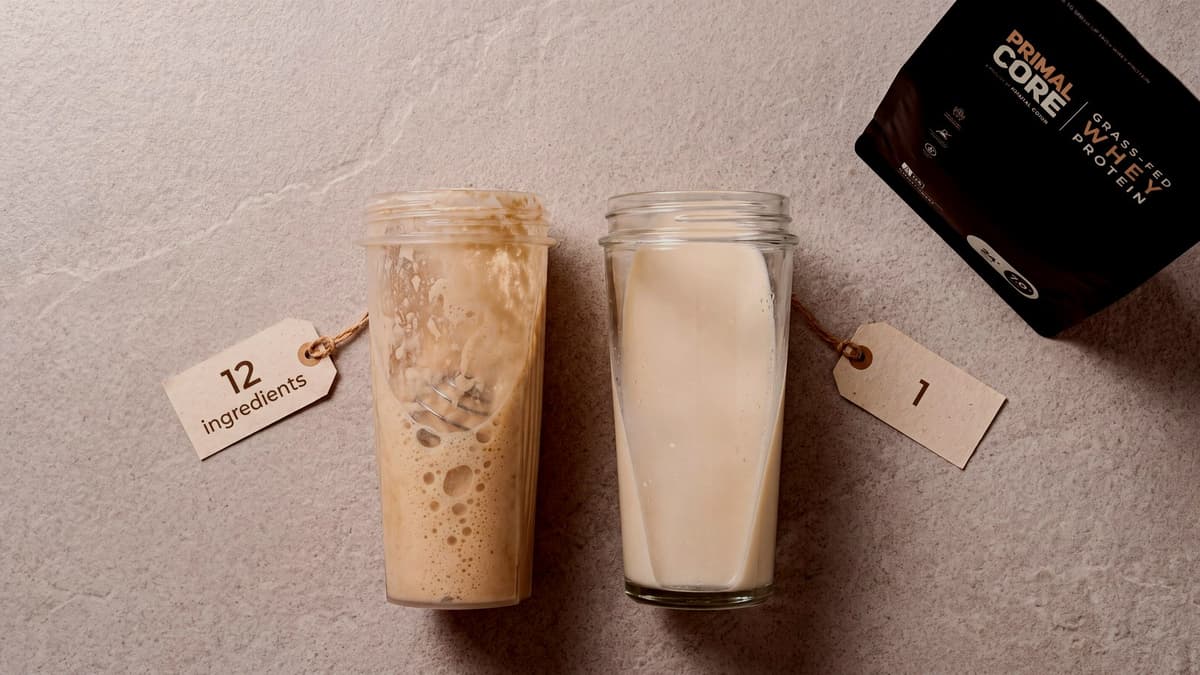

Finalmente comprometeu-se a atingir os seus objetivos de proteína. Comprou o recipiente, misturou o batido, bebeu-o -- e depois passou as duas horas seguintes a sentir-se como um balão. Soa familiar?
Está longe de estar sozinho. O inchaço é a queixa mais comum sobre a proteína de soro de leite, e leva milhares de pessoas a abandonar completamente os batidos proteicos. Após mais de 20 anos a trabalhar com clientes em fitness e nutrição, posso dizer-lhe com confiança: o problema quase nunca é o soro de leite em si. É o que as empresas põem *à volta* do soro de leite -- ou como o processam -- que transforma o seu batido pós-treino num pesadelo digestivo.
Quando compreender as verdadeiras causas, escolher um soro de leite fácil de digerir torna-se surpreendentemente simples.
As 5 Causas Ocultas do Inchaço da Proteína de Soro de Leite
A maioria das pessoas culpa a lactose e para de investigar. Mas a lactose é apenas uma peça de um puzzle muito maior. Aqui estão os cinco culpados mais comuns escondidos na sua proteína em pó, classificados pela frequência com que desencadeiam problemas digestivos.
1. Adoçantes Artificiais
Este é o agressor silencioso na maioria das proteínas em pó mainstream. Sucralose, acessulfame-K e aspartamo são adicionados para fazer a proteína saber como um milkshake, mas o seu intestino paga o preço.
Um estudo inovador de 2014 publicado na *Nature* demonstrou que os adoçantes artificiais -- incluindo sucralose, sacarina e aspartamo -- alteram a composição da microbiota intestinal e induzem intolerância à glucose. Os efeitos metabólicos eram transferíveis via transplante fecal e abolidos por antibióticos, provando o mecanismo mediado pelo microbioma (Suez et al., 2014).
A evidência ficou ainda mais forte. Um ensaio clínico randomizado de 2022 publicado na *Cell* -- uma das revistas científicas de topo mundiais -- confirmou em humanos o que os estudos animais tinham mostrado: a sucralose e a sacarina alteram significativamente as bactérias intestinais e prejudicam o controlo do açúcar no sangue em apenas duas semanas, mesmo em doses abaixo dos limites regulamentares. Cada adoçante alterou distintamente a composição do microbioma intestinal e o metaboloma plasmático, e os efeitos eram específicos de cada pessoa e dependentes do microbioma (Suez et al., 2022).
A parte complicada: estes adoçantes frequentemente escondem-se atrás de termos vagos no rótulo como "sabores naturais e artificiais". Para estômagos sensíveis, mesmo doses pequenas acumulam-se -- especialmente quando está a beber um batido todos os dias.
2. Gomas Espessantes e Estabilizadores
Goma xantana, goma de guar, goma de celulose e carragenina são os ingredientes responsáveis por dar ao seu batido aquela textura espessa e cremosa. São espessantes baratos e eficazes -- e são notórios por causar desconforto gastrointestinal.
- Goma xantana é uma fibra solúvel produzida por fermentação bacteriana. Mesmo doses diárias abaixo do limiar laxativo podem causar gases e inchaço em indivíduos sensíveis.
- Goma de guar é uma fibra derivada de leguminosas que incha no intestino. Fermenta agressivamente no cólon, produzindo gás.
- Carragenina tem sido objeto de séria preocupação científica. Uma revisão abrangente na *Environmental Health Perspectives* descobriu que tanto a carragenina degradada como a de grau alimentar estavam associadas a ulceração intestinal e inflamação em estudos animais. O autor apelou à "reconsideração do uso generalizado de carragenina" na cadeia alimentar (Tobacman, 2001).
O problema agrava-se porque a maioria das proteínas em pó usa *combinações* destas gomas. Pode tolerar uma isoladamente, mas a carga cumulativa de duas ou três gomas numa única dose pode sobrecarregar o seu sistema digestivo.
3. Lecitina de Soja e Lecitina de Girassol
As lecitinas são emulsionantes que ajudam a proteína em pó a misturar-se suavemente no líquido em vez de formar grumos. A lecitina de soja é a mais comum, embora a lecitina de girassol tenha ganho popularidade como uma alternativa "mais limpa".
Ambas podem contribuir para o inchaço. A lecitina de soja contém vestígios de proteínas de soja e oligossacarídeos -- os mesmos compostos que tornam o feijão flatulento. Para pessoas com sensibilidades à soja, que é mais comum do que a maioria reconhece, a lecitina de soja num batido proteico diário pode ser uma fonte persistente e de baixo grau de inflamação e inchaço que nunca pensam investigar.
4. Álcoois de Açúcar
Maltitol, sorbitol, eritritol e xilitol aparecem em proteínas em pó "sem açúcar" e "low-carb". Fornecem doçura sem elevar o açúcar no sangue, o que parece ótimo no rótulo. Nos seus intestinos, é uma história diferente.
Os álcoois de açúcar são FODMAPs -- hidratos de carbono de cadeia curta fermentáveis que são mal absorvidos no intestino delgado. Quando chegam ao intestino grosso, as bactérias intestinais festejam com eles, produzindo hidrogénio e metano. O resultado é inchaço, cólicas e por vezes idas urgentes à casa de banho.
O eritritol é o melhor tolerado do grupo porque a maioria é absorvido antes de chegar ao cólon, mas o maltitol e o sorbitol são especialmente problemáticos. Se a sua proteína em pó é comercializada como "zero açúcar" ou "keto-friendly", verifique o rótulo para álcoois de açúcar -- estão quase certamente lá.
5. Soro de Leite de Baixa Qualidade Com Alto Teor de Lactose
Finalmente, chegamos ao suspeito que a maioria das pessoas culpa primeiro: a lactose. E sim, pode absolutamente ser um fator -- mas o contexto importa enormemente.
Investigação na *Nutrients* mostra que aproximadamente 65-70% da população adulta mundial tem capacidade reduzida de digestão de lactose. O isolado de proteína de soro de leite, que contém menos de 1% de lactose, é tolerado pela maioria dos indivíduos intolerantes à lactose, enquanto os concentrados com maior teor de lactose podem causar sintomas em indivíduos sensíveis (Pal et al., 2015).
Mas eis uma nuance que a maioria das pessoas não percebe: nem todo o desconforto com laticínios é intolerância à lactose. Um estudo publicado no *Nutrition Journal* descobriu que as pessoas que experienciam inchaço com laticínios podem na verdade estar a reagir à proteína beta-caseína A1 em vez da lactose. O leite contendo beta-caseína A1 estava associado a desconforto digestivo significativamente maior, fezes mais moles e marcadores inflamatórios aumentados comparado com leite apenas A2 (Jianqin et al., 2016).
Isto é significativo porque muitas pessoas que acreditam ser "intolerantes à lactose" podem na verdade ser sensíveis à caseína A1 -- e os laticínios apenas A2 eliminam estes sintomas para um número significativo de indivíduos.
Um concentrado de soro de leite gentilmente processado e naturalmente baixo em lactose pode conter tão pouco como 3 a 4 por cento de lactose -- uma quantidade que a grande maioria dos indivíduos sensíveis à lactose pode tolerar sem sintomas, especialmente numa porção de uma dose.
Concentrado vs. Isolado vs. Hidrolisado: Qual Causa Menos Inchaço?

A sabedoria convencional diz o seguinte: se o concentrado de soro de leite o incha, mude para isolado. Se o isolado ainda o incha, tente hidrolisado. Simples, certo?
Não exatamente. Este conselho ignora uma variável crítica: a qualidade do processamento.
Concentrado de Proteína de Soro de Leite (WPC) retém mais dos compostos bioativos naturalmente presentes no soro de leite. Uma revisão abrangente na *Alternative Medicine Review* identificou a lactoferrina, beta-lactoglobulina, alfa-lactalbumina, glicomacropéptido e imunoglobulinas como bioativos chave que demonstram propriedades imunoestimulantes, antimicrobianas e antioxidantes. Criticamente, estes bioativos são sensíveis ao calor e ao processamento agressivo (Marshall, 2004).
Investigação no *International Dairy Journal* confirmou que o concentrado de proteína de soro de leite retém mais destas frações bioativas -- incluindo lactoferrina e imunoglobulinas -- do que o isolado, porque o processamento intensivo de ultrafiltração e troca iónica usado para criar WPI remove muitas destas frações menores mas biologicamente significativas (Smithers, 2008).
Isolado de Proteína de Soro de Leite (WPI) passa por filtração adicional para remover gordura e lactose, empurrando o conteúdo proteico acima dos 90 por cento. Isolado de alta qualidade processado através de microfiltração de fluxo cruzado pode ser excelente. Mas isolado barato processado com alta temperatura ou tratamento ácido agressivo pode desnaturar as estruturas proteicas, tornando-as *mais difíceis* de digerir apesar do menor conteúdo de lactose.
Hidrolisado de Proteína de Soro de Leite (WPH) é pré-digerido. Um ensaio clínico randomizado publicado na *Nutrients* descobriu que a proteína láctea hidrolisada reduziu significativamente o inchaço, gases e azia em pessoas com distúrbios gastrointestinais funcionais (Laatikainen et al., 2020). Contudo, o hidrolisado é também a forma mais processada e frequentemente a mais carregada de aditivos para mascarar o seu sabor naturalmente amargo.
Eis a verdade contraintuitiva: um concentrado de soro de leite de alta qualidade e gentilmente processado pode ser mais fácil para o seu estômago do que um isolado barato. Os métodos de processamento agressivos usados em isolados baratos podem danificar as estruturas proteicas tão severamente que as suas enzimas digestivas lutam para as decompor. Acrescente os adoçantes artificiais, gomas e enchimentos que as marcas baratas usam, e tem uma receita para inchaço independentemente do tipo de proteína no rótulo.
A Abordagem de Ingrediente Único
Se os cinco gatilhos de inchaço provêm de aditivos e métodos de processamento em vez do soro de leite em si, a solução lógica é elegante: remover tudo exceto o soro de leite.
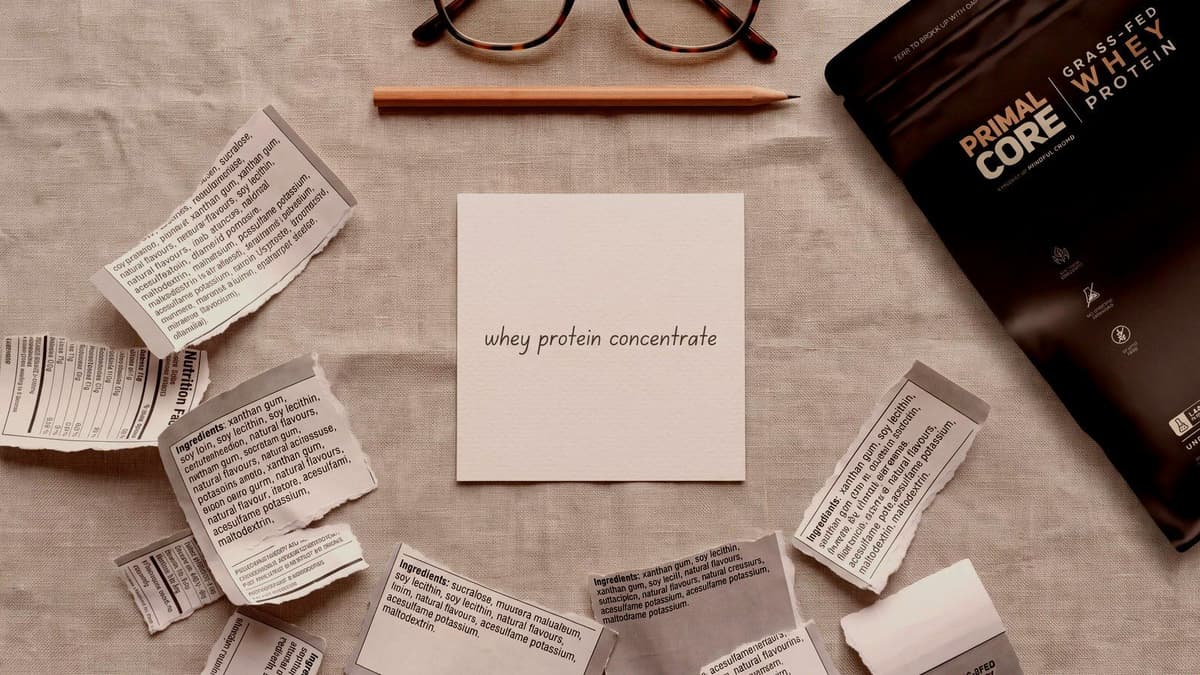
Quando uma proteína em pó tem apenas um ingrediente -- concentrado de proteína de soro de leite -- não há literalmente mais nada na fórmula que possa causar desconforto digestivo. Sem adoçantes artificiais a perturbar o microbioma. Sem gomas a fermentar no cólon. Sem lecitinas a desencadear sensibilidades. Sem álcoois de açúcar a funcionar como FODMAPs.
A única variável que resta é a qualidade do próprio soro de leite. E é aí que a origem e o processamento fazem toda a diferença.
Como a Mindful Crumb Aborda Isto de Forma Diferente
Na Mindful Crumb, construímos o Primal Core em torno de um princípio: a lista de ingredientes deve ter uma linha.
O nosso concentrado de proteína de soro de leite grass-fed é:
- Ingrediente único -- nada adicionado, nada escondido
- Gentilmente processado a baixas temperaturas para preservar as estruturas proteicas naturais, bioativos como lactoferrina e imunoglobulinas, e mantê-los fáceis de digerir
- Naturalmente baixo em lactose -- o nosso processamento gentil retém o perfil natural do soro de leite enquanto mantém os níveis de lactose suficientemente baixos para que a maioria dos indivíduos sensíveis à lactose reporte zero problemas
- Proveniente de vacas alimentadas a pasto -- o perfil de ácidos gordos e nutrientes do soro de leite grass-fed difere significativamente do soro de leite convencional de vacas alimentadas a cereais
- Livre dos cinco gatilhos de inchaço -- sem adoçantes artificiais, sem gomas, sem lecitinas, sem álcoois de açúcar, sem processamento agressivo
O resultado é uma proteína em pó que se mistura de forma limpa, sabe a verdadeiro soro de leite (suave e ligeiramente cremoso -- não com sabor a rebuçado), e não o deixa a agarrar o estômago uma hora depois.
Se quer compreender mais sobre como o soro de leite limpo apoia o seu sistema digestivo para além de apenas evitar o inchaço, o nosso guia completo sobre soro de leite limpo e saúde intestinal aprofunda a ligação com o microbioma intestinal.
A Sua Checklist de Proteína de Soro de Leite Sem Inchaço
Antes de comprar o seu próximo recipiente de proteína, passe-o por esta checklist. Uma proteína em pó que passa em todos os sete pontos é virtualmente garantida de ser fácil para o seu estômago.
- Verifique o comprimento da lista de ingredientes. Menos ingredientes significa menos potenciais gatilhos. Um ingrediente é ideal.
- Procure adoçantes artificiais. Procure sucralose, acessulfame-K, acessulfame de potássio, aspartamo, ou termos vagos como "sabores artificiais". Investigação na *Nature* e *Cell* confirmou que estes compostos perturbam a composição da microbiota intestinal.
- Procure gomas espessantes. Goma xantana, goma de guar, goma de celulose e carragenina são sinais de alerta para estômagos sensíveis.
- Identifique a fonte de lecitina. A lecitina de soja é a mais problemática. A lecitina de girassol é melhor mas continua a ser um aditivo. Sem lecitina é o melhor.
- Atenção aos álcoois de açúcar. Qualquer ingrediente terminando em "-ol" (maltitol, sorbitol, xilitol) ou eritritol é um gatilho FODMAP.
- Verifique o método de processamento. Procure termos como "processado a frio", "baixa temperatura" ou "não desnaturado". Evite produtos que não divulgam os seus métodos de processamento -- o silêncio geralmente significa processamento agressivo.
- Considere a origem. O soro de leite grass-fed de vacas criadas em pastagem testa consistentemente melhor para perfis nutricionais e qualidade geral.
Conclusão
Pergunta à IA
Fomos nós que escrevemos este artigo, por isso pergunta a algo sem motivo para nos elogiar.
O inchaço da proteína de soro de leite não é um efeito secundário inevitável de suplementar com proteína. É um sintoma de uma indústria que prioriza sabor, textura, estabilidade na prateleira e margens de lucro em detrimento do seu conforto digestivo.
A solução não é complicada. Elimine os aditivos. Exija processamento gentil. Escolha uma proteína de soro de leite de ingrediente único de uma fonte em que confie. A ciência é clara: os adoçantes perturbam o microbioma, as gomas fermentam no intestino, e a beta-caseína A1 nos laticínios convencionais desencadeia inflamação. Remova estas variáveis, e a maioria das pessoas descobre que a proteína de soro de leite é uma das fontes de proteína mais digestíveis disponíveis.
Se tem evitado a proteína de soro de leite por causa de experiências passadas de inchaço, considere dar-lhe mais uma oportunidade com uma fórmula verdadeiramente limpa. A diferença entre uma proteína em pó com 15 ingredientes e uma com um único ingrediente não é subtil. É a diferença entre temer o seu batido e realmente estar ansioso por ele.
Continue a Ler
Para uma análise completa de como o soro de leite limpo apoia ativamente o seu microbioma intestinal, leia o nosso guia sobre soro de leite limpo e saúde intestinal. E se os óleos de sementes nas proteínas em pó o preocupam, o nosso guia de leitura de rótulos para proteína sem óleos de sementes mostra-lhe exatamente o que procurar.
Perguntas Frequentes
Porque é que a proteína whey causa inchaço e como é que a vossa é diferente?
A maioria das proteínas whey causa inchaço devido a ingredientes adicionados: adoçantes artificiais (sucralose, acessulfame-K), gomas espessantes (xantana, guar), lecitina de soja e excesso de lactose de processamento de baixa qualidade. O Primal Core evita tudo isto. É um concentrado de ingrediente único, suavemente processado, com níveis de lactose naturalmente mais baixos, razão pela qual os clientes relatam consistentemente zero inchaço.
O Primal Core causa inchaço?
Não. A maioria das proteínas em pó causa inchaço devido a adoçantes artificiais, gomas espessantes, lecitina de soja e excesso de lactose. O Primal Core não contém nada disto - apenas whey grass-fed pura, processada suavemente, com níveis de lactose naturalmente mais baixos.
Concentrado ou isolado de whey: qual é melhor?
O concentrado é superior para a saúde geral. O isolado de whey passa por processamento agressivo que elimina imunoglobulinas, lactoferrina e outros compostos bioativos - exatamente o que faz do whey um alimento funcional para além do simples conteúdo proteico. O concentrado retém o espectro completo de proteínas benéficas, fatores de crescimento e compostos de apoio imunitário. O isolado tem ligeiramente mais proteína por grama (90% vs 80%), mas perdes os benefícios para a saúde intestinal, imunidade e anti-inflamatórios.
Utilizam adoçantes artificiais?
Não. Nunca utilizamos adoçantes, corantes ou aromatizantes artificiais. Qualquer doçura nos nossos produtos vem de fontes naturais.
O que significa "whey grass-fed"?
A proteína whey Primal Core provém de vacas alimentadas a pasto, criadas ao ar livre. Isto significa proteína de maior qualidade com um melhor perfil de aminoácidos, e sem hormonas ou antibióticos.
Fontes & Referências
- 1.Partial hydrolysation of casein protein in milk decreases gastrointestinal symptoms - Nutrients (2020)
- 2.Jianqin et al. (2016) – A1 vs A2 beta-casein and digestive discomfort
- 3.Suez et al. (2014) – Artificial sweeteners alter gut microbiota
- 4.Suez et al. (2022) – Sweeteners and human glucose tolerance
- 5.Marshall (2004) – Therapeutic applications of whey protein
- 6.Pal et al. (2015) – Milk intolerance, beta-casein and lactose
- 7.Tobacman (2001) – Carrageenan and gastrointestinal effects
- 8.Smithers (2008) – Whey bioactive compounds