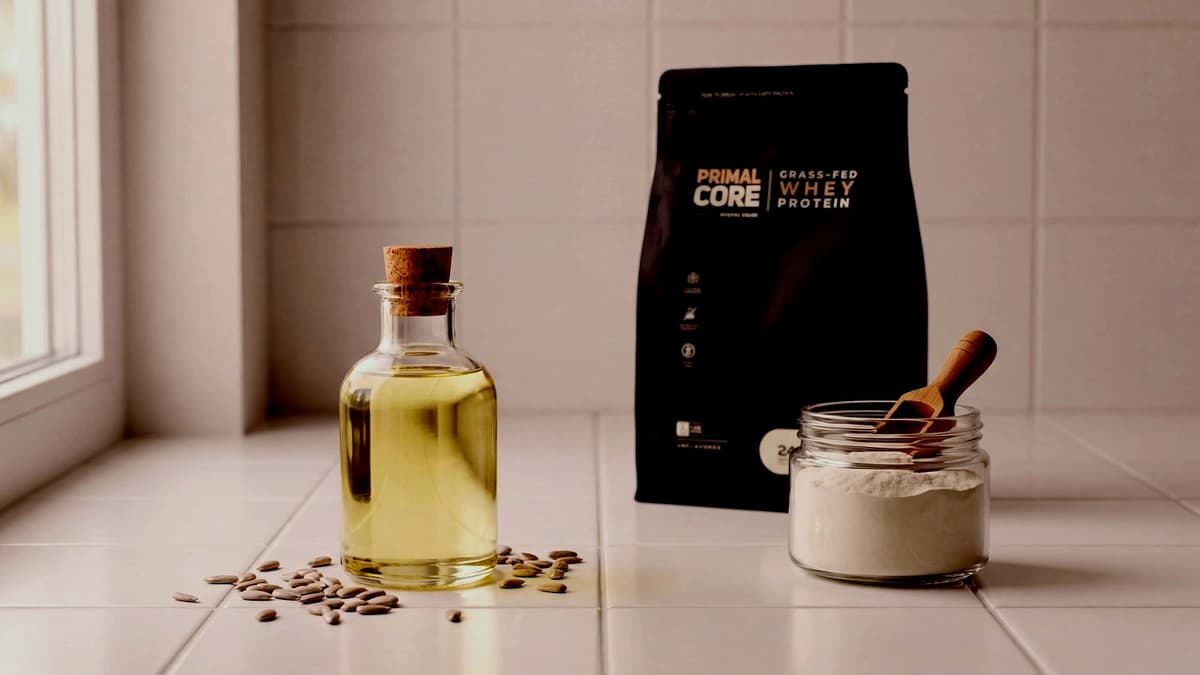

Batidos de proteína sem óleos de sementes existem, mas são raros - a maioria das marcas esconde lecitina de girassol, óleo de canola ou óleo vegetal nos ingredientes. Os únicos batidos de proteína verdadeiramente sem óleos de sementes usam whey de ingrediente único sem nada adicionado (sem emulsionantes, sem enchimentos). Se o rótulo lista algo além de concentrado ou isolado de proteína de whey, provavelmente estás a olhar para óleos de sementes com um nome diferente.
Como alguém que trabalha em fitness e nutrição há mais de duas décadas, vi a consciencialização sobre ingredientes evoluir de uma preocupação de nicho para uma prioridade mainstream. A atenção crescente sobre os óleos de sementes não é uma tendência marginal -- é impulsionada por um corpo genuíno e crescente de evidência científica que liga estes óleos industriais à inflamação crónica.
Então, qual é a verdadeira história? Onde se escondem os óleos de sementes nas proteínas em pó, por que deve importar-se, e como encontrar uma opção genuinamente limpa? Vamos analisar tudo.
Por Que os Óleos de Sementes na Proteína em Pó São uma Preocupação Crescente
Os óleos de sementes -- óleo de soja, óleo de girassol, óleo de colza, óleo de cártamo e óleos vegetais industrialmente processados semelhantes -- tornaram-se alguns dos ingredientes mais debatidos na nutrição moderna. A preocupação centra-se na sua concentração excecionalmente elevada de ácidos gordos polinsaturados ómega-6, particularmente o ácido linoleico.
Em pequenas quantidades, as gorduras ómega-6 são essenciais. O problema é a escala. Uma revisão de referência publicada na *Biomedicine & Pharmacotherapy* descobriu que os humanos evoluíram com uma dieta com um rácio de ómega-6 para ómega-3 de aproximadamente 1:1. As dietas ocidentais modernas agora fornecem um rácio de 15 a 16,7:1. Este excesso de ómega-6 promove a patogénese de muitas doenças inflamatórias incluindo doenças cardiovasculares, cancro e condições autoimunes. Um rácio de 2-3:1, por contraste, suprime a inflamação em pacientes com artrite reumatoide, e um rácio de 5:1 beneficia pacientes com asma (Simopoulos, 2002).
O aumento dramático no consumo de óleos de sementes ao longo do último século -- elevando o rácio ómega-6 para ómega-3 de 1:1 para 15:1 -- é um contribuidor major para o aumento das doenças inflamatórias crónicas (Simopoulos, 2006). Isto não é especulação. É ciência nutricional e evolutiva bem documentada.
Quando a sua proteína em pó -- algo que pode consumir todos os dias -- contém óleos de sementes, contribui silenciosamente para esse desequilíbrio. Uma porção pode parecer insignificante. Multiplique-a ao longo de meses e anos de uso diário, e a carga cumulativa torna-se mais difícil de ignorar.
Onde se Escondem os Óleos de Sementes nas Proteínas em Pó

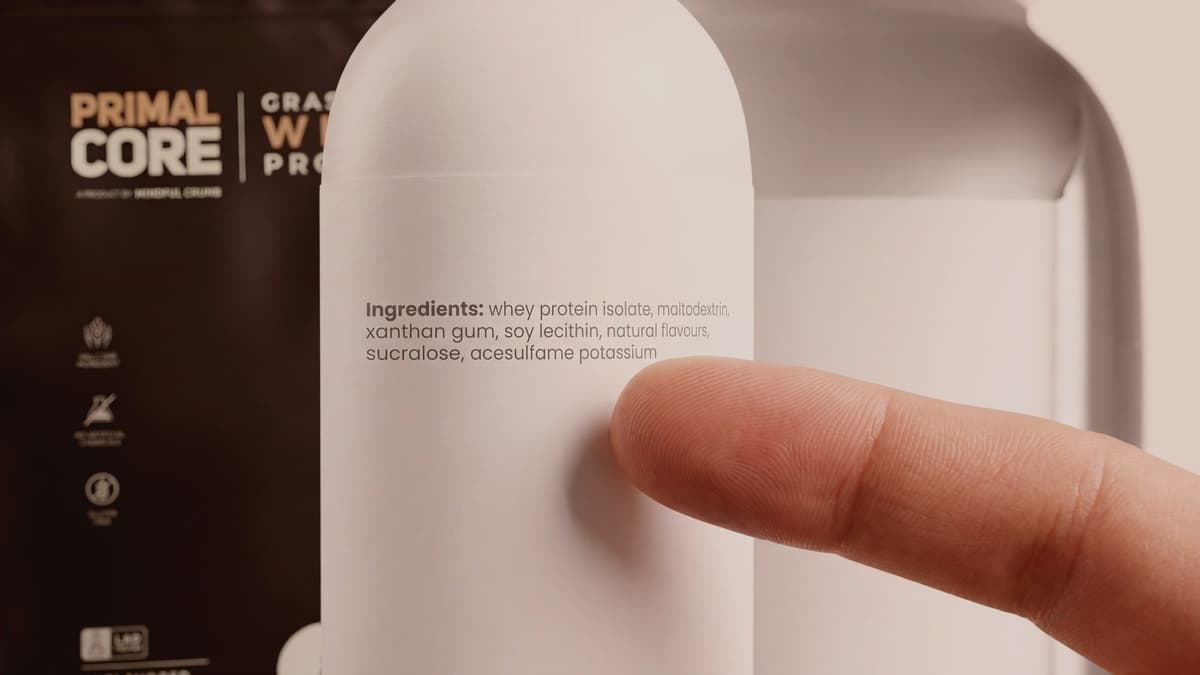
É aqui que as coisas se tornam interessantes, e um pouco frustrantes. Os óleos de sementes raramente aparecem num rótulo de proteína em pó como "óleo de sementes". Disfarçam-se sob nomes que parecem técnicos ou inofensivos.
Lecitina de girassol é uma das mais comuns. É usada como emulsionante para melhorar a misturabilidade. Os fabricantes adoram-na porque evita que o pó forme grumos e ajuda-o a dissolver-se suavemente na água. Mas a lecitina de girassol é derivada do óleo de girassol, e embora o processo de extração de lecitina reduza o conteúdo total de óleo, não o elimina.
Lecitina de soja serve o mesmo propósito e carrega preocupações semelhantes, com a consideração adicional de que a maioria da soja convencional é geneticamente modificada e fortemente processada.
Misturas de óleos vegetais por vezes aparecem em proteínas em pó comercializadas como substitutos de refeição ou gainers. Estas misturas são tipicamente combinações de óleos de colza, girassol e soja adicionados para aumentar o conteúdo calórico.
"Sabores naturais" é o curinga. Este termo abrangente pode legalmente abranger uma vasta gama de compostos, incluindo transportadores à base de óleo e solventes de sabor. Um artigo de 2023 no *Journal of Nutrition* revelou que até 87% dos rótulos de suplementos alimentares usam misturas proprietárias que escondem as quantidades individuais de ingredientes, tornando impossível verificar o que realmente está a consumir (Dalton et al., 2023).
Aditivos cremosos e melhoradores de textura em proteínas em pó com sabor frequentemente dependem de ingredientes derivados de óleos de sementes para alcançar aquela consistência suave e cremosa que os consumidores esperam das variedades de chocolate ou baunilha.
A Ciência: O Que Acontece Quando o Ómega-6 Se Acumula
O argumento biológico contra o consumo excessivo de óleos de sementes está fundamentado em bioquímica bem estabelecida. Uma revisão publicada na *Open Heart* explica o mecanismo claramente: o excesso de ómega-6 dos óleos de sementes é metabolizado em ácido araquidónico, que produz prostaglandinas pró-inflamatórias (PGE2), tromboxanos (TXA2) e leucotrienos (LTB4). Estes compostos estão implicados em doenças cardiovasculares, artrite e disfunção metabólica (DiNicolantonio & O'Keefe, 2018).
Uma revisão de 2018 na *Prostaglandins, Leukotrienes and Essential Fatty Acids* acrescentou uma nuance crítica: embora o ácido linoleico em si nem sempre aumente diretamente os marcadores inflamatórios em adultos saudáveis, os seus metabolitos oxidados -- chamados OXLAMs (metabolitos oxidados de ácido linoleico) -- ativam o NF-kB, uma via inflamatória mestra. Estes metabolitos oxidados formam-se facilmente quando os óleos de sementes são expostos ao calor, luz ou armazenamento prolongado (Innes & Calder, 2018).
Isto importa enormemente para as proteínas em pó. Considere o processo de fabrico: emulsionantes derivados de óleos de sementes são adicionados à proteína em pó durante a produção, depois o pó permanece nas prateleiras durante meses ou anos. Cada vez que abre o recipiente, expõe estas gorduras polinsaturadas ao ar e à luz. O potencial de oxidação não é trivial.
Para alguém que consome um batido proteico diariamente -- frequentemente pós-treino, quando o corpo está em estado de recuperação e a absorção de nutrientes está elevada -- introduzir gorduras oxidadas ou pró-inflamatórias durante essa janela é contraproducente para todo o propósito de suplementar com proteína.
Como Ler um Rótulo de Proteína em Pó Como um Detetive
Tornar-se um leitor de rótulos confiante é uma das competências mais valiosas que pode desenvolver para a sua saúde. Eis uma abordagem sistemática para avaliar qualquer proteína em pó.
Comece pela lista de ingredientes, não pelo painel nutricional. O painel nutricional diz-lhe os macros. A lista de ingredientes diz-lhe o que está realmente a comer. São duas coisas muito diferentes.
Conte os ingredientes. Quantos menos, melhor. Uma proteína em pó com 15 ou mais ingredientes quase certamente contém enchimentos, emulsionantes ou aditivos de que não precisa.
Procure estes sinais de alerta:
- Lecitina de girassol
- Lecitina de soja
- Óleo de colza, óleo de girassol, óleo de cártamo, ou qualquer "óleo vegetal"
- Sabores naturais (a menos que a empresa divulgue explicitamente o que são)
- Aditivos cremosos ou "mistura cremosa"
- Maltodextrina (não é um óleo de sementes, mas um marcador comum de um produto altamente processado)
Procure o que deve estar lá:
- Uma fonte de proteína claramente identificada (concentrado de soro de leite, isolado de soro de leite, caseína, etc.)
- Ingredientes adicionais mínimos
- Testes de terceiros ou informação transparente de origem
Verifique a ordem dos ingredientes. Os ingredientes são listados por peso, em ordem decrescente. Se um emulsionante ou óleo aparece no topo da lista, representa uma porção significativa do produto.
A Solução de Ingrediente Único
Eis a forma mais simples e eficaz de garantir que a sua proteína em pó é livre de óleos de sementes: escolha uma com apenas um único ingrediente.
Se o único ingrediente listado é concentrado de proteína de soro de leite -- nada mais -- não há literalmente onde os óleos de sementes se esconderem. Sem emulsionantes. Sem transportadores de sabor. Sem misturas de óleos vegetais. Sem ambíguos "sabores naturais". Apenas proteína.
Esta é a abordagem por detrás do Primal Core Grass-Fed Whey Protein Concentrate. Um ingrediente. É tudo. O rótulo inteiro lê-se como concentrado de proteína de soro de leite de vacas alimentadas a pasto. Sem lecitina de girassol. Sem lecitina de soja. Sem óleos de sementes de qualquer tipo.
A proteína de ingrediente único também torna-a notavelmente fácil de usar como base para outras receitas. Controla o que entra. Use-a em smoothies, misture-a na aveia, ou use-a como base proteica para algo como Crumb Balls -- onde escolhe cada ingrediente adicional.
Pergunta à IA
Fomos nós que escrevemos este artigo, por isso pergunta a algo sem motivo para nos elogiar.
Por Que a Origem Grass-Fed Importa para um Perfil Lipídico Limpo
Escolher proteína livre de óleos de sementes é uma parte da equação. A origem da própria proteína é a outra.
O maior estudo dos EUA do seu tipo descobriu que o leite biológico tem 62% mais ácidos gordos ómega-3 do que o leite convencional, e 25% menos ómega-6. O rácio ómega-6 para ómega-3 era de 2,28 no biológico vs. 5,77 no leite convencional. Mais impressionante, o leite 100% grass-fed mostrou um rácio ainda mais favorável de apenas 0,95 (Benbrook et al., 2013, *PLoS ONE*).
Os laticínios grass-fed mostram consistentemente níveis mais elevados de ácidos gordos ómega-3, ácido linoleico conjugado (CLA) e vitaminas lipossolúveis como a vitamina K2. O rácio ómega-6 para ómega-3 nos laticínios grass-fed é naturalmente mais favorável -- o que se alinha diretamente com o objetivo de reduzir a ingestão de gorduras inflamatórias.
Para além do perfil lipídico, a origem grass-fed tipicamente significa ausência de antibióticos de rotina, ausência de hormonas de crescimento adicionadas, e animais criados em pastagem em vez de em operações de confinamento. Quando uma proteína em pó é simultaneamente de ingrediente único e grass-fed, obtém a versão mais limpa possível de soro de leite.
A Sua Checklist para Escolher Proteína Sem Óleos de Sementes
Use isto como referência rápida da próxima vez que estiver a avaliar uma proteína em pó:
- Ingrediente único ou ingredientes mínimos. Menos ingredientes significa menos lugares onde os óleos de sementes se podem esconder.
- Sem lecitina de girassol ou lecitina de soja. Estes são os aditivos derivados de óleos de sementes mais comuns nas proteínas em pó.
- Sem misturas de óleos vegetais. Se qualquer forma de óleo de colza, girassol, cártamo ou soja aparece, passe à frente.
- "Sabores naturais" transparentes ou nenhuns. Se a marca não consegue dizer-lhe exatamente o que os seus sabores naturais contêm, isso é um sinal de alerta.
- Origem grass-fed. Para um perfil lipídico mais limpo e qualidade nutricional superior.
- Testado por terceiros. Testes independentes acrescentam uma camada de verificação.
- Sem misturas proprietárias. Se uma empresa se esconde atrás de nomes de misturas em vez de listar cada ingrediente claramente, não pode fazer uma escolha informada.
O Panorama Geral
Evitar óleos de sementes na sua proteína em pó não é sobre perfeição ou medo. É sobre tomar uma decisão informada sobre um produto que usa consistentemente. A ciência é clara que o desequilíbrio ómega-6 para ómega-3 ocidental promove inflamação crónica, e que os metabolitos oxidados do ácido linoleico dos óleos de sementes são um contribuidor significativo.
Pequenos inputs diários acumulam-se ao longo do tempo, para melhor ou para pior. A proteína em pó mais limpa é a mais simples. Um ingrediente. Grass-fed. Sem óleos de sementes. Sem compromissos.
Se tem curiosidade sobre como o soro de leite limpo apoia especificamente a saúde digestiva, cobrimos isso em detalhe no nosso guia sobre soro de leite limpo para saúde intestinal.
Perguntas Frequentes
A vossa proteína whey contém óleos de sementes?
De todo. O Primal Core contém exatamente um ingrediente: concentrado de proteína whey grass-fed. Sem lecitina de girassol, sem lecitina de soja, sem óleos vegetais de qualquer tipo. Muitas proteínas em pó incluem óleos de sementes como emulsionantes - nós dispensamo-los totalmente porque a nossa fórmula de ingrediente único não precisa deles.
O que torna os produtos Mindful Crumb diferentes?
Todos os produtos são feitos com ingredientes limpos e reais - sem óleos de sementes, sem conservantes artificiais, sem enchimentos. O nosso foco é nutrição funcional que sabe bem e apoia a tua saúde intestinal.
O que contém a whey protein Primal Core?
Exactamente um ingrediente: concentrado de proteína whey de vacas alimentadas a pasto. Sem adoçantes, sem aromas, sem emulsionantes, sem gomas, sem enchimentos. É a proteína whey mais limpa que se pode comprar.
Utilizam adoçantes artificiais?
Não. Nunca utilizamos adoçantes, corantes ou aromatizantes artificiais. Qualquer doçura nos nossos produtos vem de fontes naturais.
Batidos de proteína sem óleos de sementes?
Procura proteína de whey de ingrediente único sem emulsionantes ou enchimentos. A maioria das marcas adiciona lecitina de girassol (um derivado de óleo de sementes) para melhorar a mistura - se o rótulo diz algo diferente de 'concentrado de proteína de whey' ou 'isolado de proteína de whey', provavelmente contém óleos de sementes. Whey de vacas alimentadas a pasto com lactase adicionada é aceitável, desde que nada mais esteja listado.
Batidos de proteína sem óleo de sementes?
Batidos de proteína sem óleo de sementes são mais difíceis de encontrar do que pensarias - mesmo marcas 'limpas' frequentemente usam lecitina de girassol como emulsionante. A aposta mais segura é whey sem sabor, de ingrediente único, sem aditivos. Verifica termos como 'lecitina', 'óleo vegetal' ou 'aromas naturais' (que podem esconder derivados de óleo de sementes) - se qualquer um destes aparecer, não é sem óleo de sementes.
Proteína em pó sem óleo de girassol?
Óleo de girassol aparece na proteína em pó como 'lecitina de girassol' - um emulsionante usado para fazer o pó misturar suavemente. A maioria das proteínas de whey contém-no, mesmo as biológicas ou de vacas alimentadas a pasto. Para evitá-lo completamente, precisas de whey de ingrediente único sem lecitina, sem gomas e sem 'aromas naturais' listados. Se a lista de ingredientes tem mais do que um item (além de lactase opcional), óleo de girassol provavelmente está escondido lá.
Fontes & Referências
- 1.Simopoulos (2002) – Omega-6/omega-3 ratio importance
- 2.Innes & Calder (2018) – Omega-6 fatty acids and inflammation
- 3.DiNicolantonio & O'Keefe (2018) – Low omega-6/omega-3 ratio for reducing inflammation
- 4.Simopoulos (2006) – Evolutionary aspects of omega-6/omega-3 and chronic disease
- 5.Benbrook et al. (2013) – Organic vs conventional milk fatty acid composition
- 6.Dalton et al. (2023) – Proprietary blends in dietary supplements